(Wikimedia Commons, 2007)
The inspiring journey of Howard Aiken and Grace Hopper in forging the foundations of modern computing
1. Introduction
Imagine a long room filled with the relentless, rhythmic click-click-click of cascading relays. The air is warm, small indicator lights flicker in unison, and the scent of machine oil blends with the aroma of freshly punched paper tape. Behind shoulder-high glass panels, rows of gears spin smoothly, playing a mechanical symphony of the future.
Standing at the center of this room is a monolithic machine—the Harvard Mark I—one of the world’s first large-scale automatic digital computers. It was not built for luxury, nor was it designed for corporate productivity. It was born for something far greater: to help alter the course of history during the height of World War II.
The Mark I was more than just a machine. It was a monumental leap for civilization, born from the bold ambition of a visionary named Howard H. Aiken, brought to life by the brilliant engineers at IBM, and animated by pioneers like Grace Hopper. This is a written documentary—a cinematic journey that will take you back to experience how the first mechanical “brain” lived, worked, and eventually retired.
2. The Birth of a Legend: From Dream to Machine
When One Man Imagined the Future
Behind the Mark I was a man with a vision that many of his contemporaries considered downright crazy: Howard H. Aiken.
In 1937, while most scientists were still bogged down by logarithmic tables and simple mechanical calculators, Aiken—a doctoral student in Physics at Harvard University—grew deeply frustrated. Solving the complex differential equations required for his thesis took weeks of tedious manual labor.
He envisioned a massive machine that could calculate tirelessly, work through the night without complaint, and eliminate human error entirely. However, the academic community was skeptical. His proposals were rejected repeatedly until he finally knocked on the door of IBM, the undisputed giant of punched-card tabulating machinery at the time.
IBM and the Great Gamble: Between Skepticism and Faith
When Aiken presented his blueprints to Thomas Watson Sr., the CEO of IBM, the company’s engineers were stunned. A machine stretching 15 meters long? Built with hundreds of thousands of moving parts?
Some shook their heads; others flatly remarked, “It’s impossible.” Yet, Watson Sr. saw something others didn’t: the future. He gave the green light, saying, “Let’s build it.”
This ambitious project took five years at the IBM plant in Endicott, New York. Hundreds of engineers meticulously hand-assembled 765,000 mechanical and electromechanical components and ran over 800 kilometers of wire. It was as much a masterpiece of industrial art as it was a scientific instrument.
Harvard Mark I Physical Specifications (1944):
- Length: 15.5 meters.
- Height: 2.4 meters.
- Weight: 4.5 tons.
- Wiring: 800 kilometers.
The IBM Logo Drama: Aiken vs. The Corporate Giant
Even a historic machine has its share of drama. Right before the official dedication ceremony on August 7, 1944, IBM wanted to mount a large “IBM” logo on the front panels for branding. Howard Aiken fiercely opposed the idea. He insisted that the machine was a scientific instrument belonging to Harvard, not a commercial billboard.
This clash deeply strained the relationship between Aiken and Watson Sr. Eventually, a compromise was reached: no massive corporate logo graced the front, but a small plaque was installed to honor the dedication of IBM’s engineers.
3. How the Mark I Worked: A Symphony of Gears and Electricity
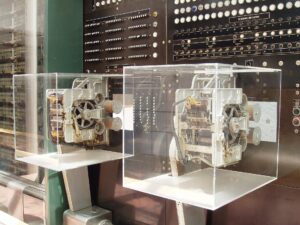
Input: The Art of Punching Tape
Forget about keyboards, mice, or monitors. To program the Mark I, operators relied on a combination of:
- 24-channel punch tape (paper tape with punched holes) for program instructions.
- Standard IBM punch cards for entering data sets.
- Mechanical switches on the front panels to input mathematical constants.
Operators spent hours carefully punching holes into paper tape. A single misplaced hole meant the entire program would crash, forcing them to start over from scratch.
Memory: Remembering with Gears, Not Silicon
The Mark I had no concept of RAM. Its primary memory consisted of 72 mechanical registers, which acted as the “brains” holding the numbers.
Each register could store a 23-digit decimal number, plus one extra position for a positive or negative sign. These numbers weren’t stored in binary code (0s and 1s) but rather through the physical rotation of decimal wheels turning from 0 to 9.
The Electromechanical Processor: Slow but Steady
As an electromechanical computer, the heart of the Mark I was driven by a 15-meter main driveshaft spun by a 5-horsepower electric motor.
Mark I Computing Speeds:
- Addition/Subtraction: 0.3 seconds
- Multiplication: ~6.0 seconds
- Division: ~15.7 seconds
By today’s standards, this is agonizingly slow. But in 1944, the ability to crunch 23-digit numbers non-stop, 24 hours a day without mental fatigue, was an unmatched miracle.
4. World War II: The Silent Weapon Behind the Scenes (1944–1945)
The moment it became fully operational, the Mark I was immediately requisitioned by the U.S. Navy to aid the war effort. The machine calculated ballistics tables for artillery, determined firing ranges for naval battleships, and mapped out precise navigation charts.
However, its most critical assignment was top secret. The Mark I was utilized by legendary scientist John von Neumann to run complex mathematical simulations for the Manhattan Project. It was this very machine that calculated the implosion wave effects necessary to design the Fat Man atomic bomb dropped on Nagasaki.
Grace Hopper: The Mother of Modern Programming
Amidst a heavily male-dominated field stepped a brilliant Navy Lieutenant named Grace Hopper. She wasn’t just a basic operator; Hopper was the third person ever assigned to program the Mark I.
Hopper wrote the very first user manual for the Mark I, and through her time with the machine, the foundational culture of programming was born.
While working on its successor, the Mark II, Hopper’s team discovered a dead moth trapped inside a relay, causing the machine to malfunction. They retrieved the moth, taped it into their logbook, and noted: “First actual case of a bug being found.” The terms “bug” and “debugging” were popularized right then and there.
5. Post-War Service and the Road to Retirement (1946–1959)
Once the war ended, the Mark I was released from its military duties and transitioned into pure academic research at Harvard. For over a decade, this stubborn old giant continued to solve complex scientific riddles:
- Mapping planetary and satellite orbits.
- Calculating mathematical tables and Bessel functions (which scientists relied on well into the 1960s).
- Running early computations for quantum physics and fluid mechanics.
Even as newer, lightning-fast electronic computers using vacuum tubes (like the ENIAC) emerged, the Mark I held a distinct advantage: reliability. While vacuum tube computers frequently broke down every few hours due to burned-out tubes, the purely mechanical Mark I could run for days without a major error.
But time eventually caught up. By 1959, mechanical replacement parts became scarce, maintenance costs skyrocketed, and tiny transistor-based computers had arrived. In 1959, after 15 years of uninterrupted service, the Harvard Mark I was officially powered down for the last time.
6. Conclusion: The Endless Legacy of a Giant
The Harvard Mark I is not merely a relic of a bygone era; it is the cornerstone of the digital civilization we enjoy today. Though the electromechanical era has long been eclipsed by silicon chips and quantum computing, the Mark I proves that the greatest technological leaps always stem from the courage to break the boundaries of one’s time.
Through the blend of Howard Aiken’s academic vision, IBM’s industrial backing, and Grace Hopper’s pragmatic genius, this machine did more than just help win a war—it laid the blueprint for modern computer science.
The Harvard Architecture it pioneered (separating program instructions from data) remains a staple in modern microprocessors and smartphones. Furthermore, Hopper’s experience with the Mark I inspired her to create the world’s first compiler, paving the way for high-level programming languages like COBOL that allowed humans to talk to machines using words instead of punched holes.
Yet, if Howard Aiken and Grace Hopper could see you holding that smartphone today, they wouldn’t be surprised by its size. They would simply smile with pride—knowing that the 4.5-ton electromechanical giant they built with sweat and determination in 1944 was the very first step that made our boundless digital future possible.
Which part of the Mark I documentary resonates with you the most? Is it Howard Aiken’s relentless drive to push past the limits of his era, Grace Hopper’s brilliance in redefining how humans interact with machines, or the 4.5-ton mechanical symphony itself, spinning in silence to change the course of human history?
References
Collection of Historical Scientific Instruments, Harvard University. (n.d.). Harvard IBM Mark I – About. Harvard University. https://chsi.harvard.edu/harvard-ibm-mark-1-about
Wikimedia Commons. (2007, September 3). File: Harvard Mark I Computer – Input-Output Details.jpg. Wikipedia. https://en.wikipedia.org/wiki/File:Harvard_Mark_I_Computer_-_Input-Output_Details.jpg