How decades of relentless innovation turned warehouse-sized calculators into the ultimate pocket companions.
Introduction
Computers have become an inseparable part of modern human life. Almost every aspect of our daily activities—from working, learning, and communicating to entertainment—reies on computer technology. However, we often only view computers in their current form: small, fast, and versatile. In reality, the computer has a long history packed with monumental technological leaps.
Understanding the history of computers is not just about looking back at the past; it gives us perspective on how technology evolves. From room-sized giants that could only perform basic calculations to the laptops and smartphones we hold today, each generation of computers reflects a breakthrough that reshaped the world. By understanding their origins, we can better appreciate the tools we use today while spotting the evolutionary patterns that offer clues to our digital future.
This article provides a concise overview of the computer’s journey, from the birth of the MARK I in 1944 to the modern devices of today. By tracing each era, we will see how computers evolved from simple calculating machines into the digital brains powering almost every facet of human civilization.
1. The Early Generation of Computers (1940s — 1950s)
Early generation computers were characterized by their massive size, high power consumption, and limited capabilities. Yet, this was the defining era when the “modern computer” was born, paving the way for everything to come.
Harvard MARK I (1944)
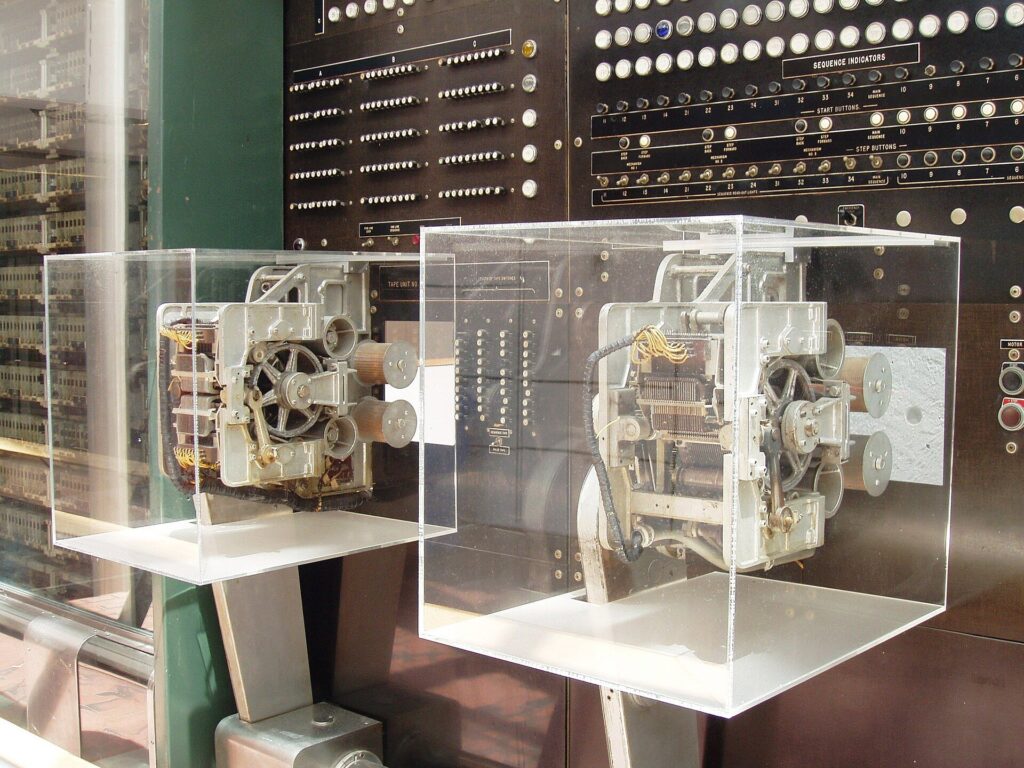
The first widely recognized modern computer was the Harvard MARK I, completed in 1944 at Harvard University with assistance from IBM. The MARK I was an electromechanical computer, meaning it still relied on a combination of mechanical parts (wheels, relays) and electricity.
- Size and Weight: It was roughly 15 meters long and weighed 5 tons.
- Function: It was primarily used for complex mathematical calculations, particularly for the U.S. Navy.
- Performance: It could perform addition and multiplication automatically, though at a snail’s pace by today’s standards.
While large and complex, the MARK I marked a major turning point: humans began relying on machines for large-scale computation, moving past basic mechanical calculators.
ENIAC (1946)
Shortly after the MARK I, the ENIAC (Electronic Numerical Integrator and Computer) was unveiled in the United States in 1946. ENIAC is widely considered the first true electronic computer because it used vacuum tubes as its primary component instead of mechanical relays.
- Performance: It was significantly faster than the MARK I, capable of performing thousands of operations per second.
- Function: It was used for ballistics calculations, nuclear research, and scientific simulations.
- Limitations: It housed around 18,000 vacuum tubes that frequently overheated and burned out. It required a room the size of a warehouse, consumed massive amounts of electricity, and required complex manual rewiring and switch adjustments to program.
UNIVAC I (1951)
In the early 1950s, the first generation of computers marketed for business and government use arrived: the UNIVAC I (Universal Automatic Computer I). Built by the Eckert-Mauchly Computer Corporation, the UNIVAC I signaled a shift from purely military and scientific applications to practical tools for commercial industries.
Key Milestone: The UNIVAC I became famous after successfully and accurately predicting the outcome of the 1952 U.S. presidential election—a historic moment that demonstrated the true power of computers in big data analysis.
General Characteristics of First-Generation Computers
- Core Component: Vacuum tubes.
- Size: Massive, room-sized installations.
- Programming Language: Binary machine code.
- Primary Use: Scientific calculations, military operations, and large-scale business data.
- Drawbacks: Prone to overheating, high power consumption, difficult to program, and extremely expensive.
This early generation, though far from practical, proved that computers could serve as an “artificial brain” to solve complex human problems. The next big leap occurred when vacuum tubes were replaced by transistors, ushering in a smaller, faster, and more reliable era.
2. Second-Generation Computers (1950s — 1960s)
After an era dominated by fragile, energy-hogging vacuum tubes, scientists made a breakthrough that changed the face of computing: the transistor. This innovation marked the birth of second-generation computers.
The Transistor: A Tiny Revolution
The transistor was invented in 1947 by John Bardeen, Walter Brattain, and William Shockley at Bell Labs. However, its widespread integration into computers didn’t take off until the early 1950s. Transistors replaced bulky vacuum tubes with tiny, highly efficient solid-state components.
The impact was immediate: computers that previously filled a whole room could now be scaled down significantly, though they were still a far cry from the personal computers we know today.
IBM 1401 (1959)
One of the most famous second-generation computers was the IBM 1401, introduced in 1959. It became a staple for corporate data processing, handling tasks like payroll and inventory management. Offered at a relatively “affordable” price point compared to its predecessors, IBM sold thousands of units, establishing itself as a titan of the tech industry.
PDP-1 (1960)
In 1960, the Digital Equipment Corporation (DEC) launched the PDP-1 (Programmed Data Processor-1). The PDP-1 was notable for pioneering the “minicomputer” category, making technology accessible to universities and research labs. Interestingly, the PDP-1 also hosted one of the very first computer video games: Spacewar!.
Advancements in Programming Languages
During this era, programmers were no longer forced to write in cryptic machine language. High-level programming languages emerged, such as COBOL (1959) for business systems and FORTRAN (1957) for scientific applications. These languages made coding more intuitive, efficient, and accessible to a broader audience.
General Characteristics of Second-Generation Computers
- Core Component: Transistors.
- Size: Noticeably smaller than the first generation, though still bulky by modern standards.
- Programming Language: Transition to high-level languages (COBOL, FORTRAN).
- Primary Use: Corporate operations (payroll, inventory), scientific research, and military use.
- Advantages: Faster, more energy-efficient, and far more reliable.
- Limitations: Still too expensive and complex for personal or consumer use.
Second-generation computers served as a vital bridge. They moved computers out of isolated military labs and into the commercial sector. More importantly, transistors laid the groundwork for further integration, which eventually birthed the Integrated Circuit (IC).
3. Third-Generation Computers (1960s — 1970s)
The next major leap came with the invention of the Integrated Circuit (IC), or silicon chip. This technology allowed engineers to pack thousands of miniature transistors onto a single, tiny flake of silicon. As a result, third-generation computers became faster, smaller, and vastly more efficient.
The Integrated Circuit: A Leap in Miniaturization
The first ICs were developed in the late 1950s by Jack Kilby (Texas Instruments) and Robert Noyce (Fairchild Semiconductor). By the early 1960s, their implementation in computers shifted the industry paradigm. Computers were no longer exclusive to massive conglomerates; they began finding homes in medium-sized organizations, universities, and government branches.
IBM System/360 (1964)
A monumental milestone of the third generation was the launch of the IBM System/360 in 1964. This was the first family of computers to feature a compatible architecture. This meant that different models within the same series could run the exact same software—a foundational concept that remains standard practice in tech today.
DEC PDP-8 (1965)
DEC made waves again by launching the PDP-8 in 1965, widely regarded as the first commercially successful minicomputer. Its lower price point democratized computing, allowing smaller laboratories and academic institutions to own a computer for the first time.
The Rise of Operating Systems & Multitasking
The third generation witnessed the birth of modern operating systems. Previously, computers could only execute one program at a time. New operating systems introduced multiprogramming and time-sharing, allowing multiple programs to run seemingly at the same time.
An early example was MULTICS (1965), which later inspired the creation of UNIX (1969). UNIX became one of the most influential operating systems in history, serving as the architectural ancestor to Linux, macOS, and Android.
General Characteristics of Third-Generation Computers
- Core Component: Integrated Circuits (ICs).
- Size: Significantly smaller and more compact.
- Programming Language: Diverse high-level languages (COBOL, FORTRAN, BASIC).
- Software: Introduction of operating systems capable of multitasking.
- Primary Use: Business enterprise, academia, government operations, and research.
- Advantages: Unprecedented processing speeds, lower costs, and greater versatility.
- Limitations: While more affordable, they were still not small or cheap enough to be personal consumer products.
4. Fourth-Generation Computers (1970s — 1990s)
While the third generation relied on basic ICs, the fourth generation arrived with an even more disruptive breakthrough: the microprocessor. By packing millions of transistors onto a single microchip via Very Large Scale Integration (VLSI), the microprocessor allowed computers to shrink down to a size that could fit on an ordinary desk.
The Microprocessor: A Brain on a Single Chip
The catalyst for this revolution was the advent of VLSI (Very Large Scale Integration) technology, which made it possible to pack thousands, and later millions, of transistors onto a single silicon chip called a microprocessor. The launch of the Intel 4004 in 1971 marked a major historic milestone as the world’s first commercial microprocessor. Although originally designed for a calculator, VLSI technology paved the way for far more compact, efficient, and powerful computers. This evolution progressed rapidly with the introduction of the Intel 8080 (1974) and Intel 8086 (1978), which ultimately standardized the architecture for personal computers (PCs).
The Birth of the Personal Computer (PC)
By the late 1970s, computers broke out of industrial environments and entered everyday homes and small businesses.
- Apple II (1977): One of the first highly successful, consumer-ready personal computers, designed by Steve Jobs and Steve Wozniak.
- IBM PC (1981): Introduced a standardized architecture for personal computing, which was widely cloned by other manufacturers, giving birth to the “IBM Compatible” era.
The Evolution of User Interfaces
The fourth generation transformed how humans interacted with machines by moving away from cryptic command lines to user-friendly environments.
- MS-DOS (1981): The dominant text-based operating system of the early PC era.
- Apple Macintosh (1984): Popularized the Graphical User Interface (GUI), complete with a mouse and desktop icons.
- Microsoft Windows (1985): Introduced a standard GUI for IBM-compatible PCs, making personal computing accessible to the masses.
The Expansion of Networks
This era also saw individual computers connect with one another on a massive scale. Ethernet (1973) became the standard for Local Area Networks (LANs) in corporate offices. By the late 1980s, the foundations of the modern internet were poured through ARPANET and the adoption of the TCP/IP protocol.
General Characteristics of Fourth-Generation Computers
- Core Component: Microprocessors utilizing VLSI technology.
- Size: Desktop-sized, giving rise to the Personal Computer (PC).
- Software: Intuitive operating systems featuring Graphical User Interfaces (GUIs).
- Networking: Birth of local area networks (LANs) and early internet protocols.
- Primary Use: Office work, household management, education, and consumer entertainment.
The fourth generation was the era when computers truly went mainstream. They transitioned from corporate machinery into essential consumer tools for work, study, and play.
5. Fifth-Generation Computers (1990s — 2000s)
Entering the 1990s and early 2000s, the computing landscape experienced a massive paradigm shift. On the hardware front, microprocessor technology leaped into the era of ULSI (Ultra Large Scale Integration), enabling engineers to embed up to billions of transistors onto a single chip, while also giving rise to highly powerful multi-core processors. While the previous generation introduced standalone personal computers, the fifth generation connected them globally through the internet and enriched them with rich multimedia experiences.
The Era of the Internet and the World Wide Web
The single biggest catalyst of this era was the internet. While network infrastructures existed prior, the launch of the World Wide Web (WWW) by Tim Berners-Lee in 1991 made the internet navigability simple for everyday citizens.
The rollout of web browsers like Netscape Navigator (1994) and Internet Explorer (1995) allowed millions to browse information online. Email, instant messaging, and web forums turned the computer into an instant, global communication hub.
The Multimedia Boom
Computers evolved beyond text and numbers to handle rich media seamlessly.
- CD-ROMs became the primary medium for software distribution, video games, interactive encyclopedias, and movies.
- Computer gaming exploded with the advent of real-time 3D graphics hardware.
- Creative software like Adobe Photoshop and presentation tools like PowerPoint expanded the computer’s role into the creative and corporate worlds.
Portable and Early Mobile Computing
Computers were no longer anchored to a desk. Laptop computers surged in popularity as they became lighter and more powerful. By the late 1990s, Personal Digital Assistants (PDAs) like the Palm Pilot offered a glimpse into the future of mobile computing.
General Characteristics of Fifth-Generation Computers
- Core Component: Ultra Large Scale Integration (ULSI) microprocessors and early multi-core processors.
- Defining Feature: Global internet connectivity and rich multimedia processing.
- Form Factor: Desktop PCs, consumer laptops, and early handheld PDAs.
- Operating Systems: Windows 95/98/XP, Mac OS, and the rise of open-source Linux.
- Limitations: Early internet connections were bottlenecked by slow dial-up speeds, mobile devices were primitive, and modern cybersecurity threats began to surface.
6. The Sixth Generation of Computers (2000s — Present)
The sixth generation defines the world we live in today: an era where computers have become ubiquitous, invisible, and deeply woven into the fabric of daily life. We no longer just “use” computers; we live within their ecosystem.
Broadband and Cloud Computing
The transition from dial-up to high-speed broadband and mobile data (4G and 5G) changed how we consume data. It enabled the explosion of on-demand video streaming (such as YouTube’s launch in 2005) and gave rise to Cloud Computing. Services like Google Drive, iCloud, and Dropbox moved file storage and processing away from local hard drives and onto remote internet servers.
The Mobile Revolution: Smartphones and Tablets
The ultimate turning point occurred in 2007 when Apple launched the iPhone, consolidating a computer, a camera, a media player, and a web browser into a single pocket-sized touchscreen device. The launch of the iPad in 2010 further bridged the gap between mobile phones and traditional laptops, supported by vast app ecosystems that offer instant software solutions for every human need.
AI, Big Data, and New Hardware Architectures
In the 2010s and beyond, Artificial Intelligence (AI) went from a sci-fi concept to consumer reality. This monumental leap was driven not only by massive pools of big data but also by a radical evolution in computer hardware. This generation is defined by the widespread utilization of high-spec GPUs (Graphics Processing Units) and specialized NPUs (Neural Processing Units)—chips specifically engineered to accelerate AI algorithms and deep learning.
The introduction of these new architectures enables computers to recognize faces and voices, pilot autonomous vehicles, and power Generative AI platforms like ChatGPT. Concurrently, this era has witnessed early, real-world experiments in quantum computing, a futuristic technology that harnesses the principles of quantum physics to process data at speeds unimaginable by traditional computers.
The Internet of Things (IoT)
Computers are no longer just screens on a desk or in our hands. Microchips are now embedded into everyday objects, creating smartwatches, smart TVs, connected home appliances, and automated industrial cities.
General Characteristics of Sixth-Generation Computers
- Core Tech: Advanced multi-core processors, specialized AI chips (GPUs/NPUs), and experimental quantum computing.
- Ecosystem: Mobile-first, cloud-reliant, globally connected, and AI-driven.
- Devices: Smartphones, ultra-thin laptops, wearables, and IoT appliances.
- Challenges: Chronic screen dependency, massive user privacy debates, complex cyber warfare, and the ethical dilemmas surrounding advanced AI.
Conclusion
The history of the computer is more than a chronicle of hardware, software, and networks. It is a reflection of human curiosity, creativity, and our relentless drive to find better ways to understand and manipulate the world around us. From the mechanical click of relays inside the MARK I to the voice of an AI assistant on your phone, computers have become the ultimate companion to human civilization.
As Alan Turing, the father of modern computer science, famously stated:
“We can only see a short distance ahead, but we can see plenty there that needs to be done.”
The ultimate question moving forward is no longer what computers can do, but how we will choose to use them. Will we harness this unprecedented power to build a more equitable, sustainable world, or will we let it compromise our collective future?
The choice rests entirely in our hands.